About Annie Cap
Annie Cap is a renowned contemporary crystalline ceramic artist and the first woman in the world to perform methanol alcohol reduction in an electric kiln.
She conducted a sold-out specialised workshop at Florida’s Dunedin Fine Arts Center (DFAC) in March 2024, focusing on her ground-breaking techniques of using methanol for atmospheric high temperature reductions and post-fire reductions for crystalline glazes, crystalline lustres, copper reds, and in-glaze lustres in electric kilns.
What makes Annie Cap notable is that she pushes crystalline ceramics beyond the expected. Her work combines the precision and chemistry of experimental crystalline glazing, with the contrasting colours, iridescent and metallic finishes, achieved through her methanol electric reduction processes.
Today her methanol techniques, and slight variations on them, are being used by other prominent crystalline and lustre artists around the world who either trained with Annie or with one of her students.
Annie Cap is a featured artist in the 2026 book release of Exploring Crystalline Glazes.
My background:
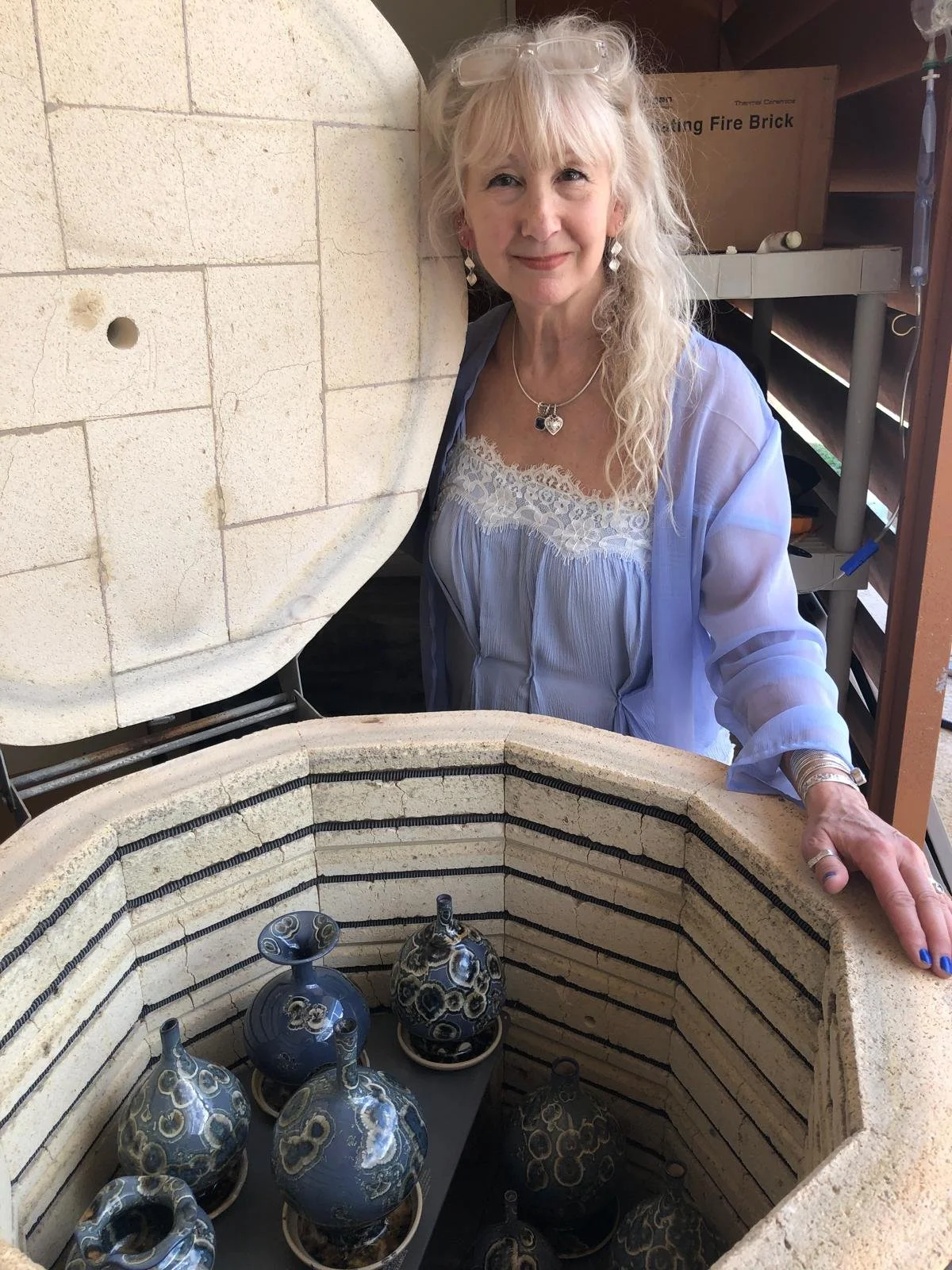
I love rocks, especially shiny obsidian, lace agates and sparkling crystals. I even collect common British flint stones where I swim year-round in the English Channel.
With a Fine Arts degree and a major in International Business, my telecommunications career brought me to London. That was 30 years ago and so much has happened.
The last telecoms company I worked for was ORGA, a German company whose visionaries (including my English husband Simon) helped create the worldwide GSM network, what know as cellular or 5G+. ORGA’s engineers also created the first SIMs and chip and pin smartcards used on bank cards (which happen to be made with silicon crystals 😉).
Whilst working for ORGA, I sold the world’s first over-the-air application (app) download system to a mobile network in England. This system was the o send apps to SIMs—the precursor to ‘smart’ phones and app stores.
After 20 years in leading-edge telecoms on two continents, and to be home when my husband came home—one of us had to stop traveling. I retrained as a holistic therapist, wrote three books and continued to exhibit and sell my paintings, until I found ceramics in 2010.
Our home and my studio are an hour from London, near Canterbury, in beautiful rural England. However, I was raised in the USA’s Pacific Northwest, in Seattle, Washington and Portland and Corvallis, Oregon.
Along with my English country cottage garden, the dramatic scenery of my childhood and the art of the indigenous Northwest Coast Peoples continue to inspire me.
My artistic goals have always been to capture or mimic Mother Nature. I am especially drawn to dramatic contrasting patterns of line and form
When my husband surprised me with a kiln and pottery wheel in 2010, my Google search showed a potter holding a crystalline platter and that was it. Once I knew you could grow real crystals on pottery I was unstoppable.
Working alone at first, I read everything I could find and started mixing glazes in our kitchen. It took 289 glaze tests before I grew my first crystal in a simple stoneware firing at my adult education class. And the rest is history.
Since then I’ve received help and training from some incredible ceramic artists, including Greg Beckman and Jose Mariscal.
The earliest and most pivotal workshop I took was with Jose Mariscal. It was five days at his Spanish studio. But, because Jose’s didn’t speak English at the time, the workshop description didn’t say the workshop was on firing crystalline glazes in reduction in gas kilns. I didn’t have a gas kiln, unlike the others who flew half-way around the world to train with Jose.
I also travelled to Florida regularly to attend DFAC crystalline workshops by Ian Childers, Matt Horne, Robert Hessler and Holly Mckeen, among others (including Jose Mariscal again). Then in 2023 I was invited to teach my crystalline electric reduction workshop there for the first time.
My ceramics are meant to look organic, like something you might dig up or find walking along a beach. In time, I learned to influence my crystal shapes and halo colours using the kiln’s temperatures and atmosphere. My crystalline glazing can look like a blue-lace agate, a starlight sky or one of Seattle’s many totem poles.
I take time and care in my making, as well as in my glaze creations, keeping special pieces for years until I’ve created a glaze and firing strategy worthy of them.
Everything I do is done in appreciation of the natural materials I use and my love of creating.
—Annie